
Hunting & Butchering
How to Freeze and Store Venison and Other Game Meat
By Furrow & Feast ·
A well-cared-for deer or elk can fill a freezer for many meals, but only if the meat is cooled first, packaged so air cannot dry it out, and used on a schedule. This guide sticks to published Extension advice for those steps. It does not invent a shelf life, a freezer temperature of its own, or a curing formula.
Safety and legality. Hunter education is required in many states. In Colorado, people born on or after January 1, 1949, must complete an approved hunter education course before applying for or purchasing a hunting license (Colorado Parks & Wildlife). Get the license and tags you need, and check seasons and regulations for the place you hunt. In Colorado, start at cpw.state.co.us. In every other state, check your state wildlife agency. This site does not recommend weapons, calibers, ammunition, optics or shooting technique. Those questions belong in hunter education.
Food-safety note. Cooling, aging, freezing, cooking, jerky, curing and smoking figures in this article come only from USDA FSIS, NCHFP or university Extension sources, linked below. We do not invent times, temperatures or cure ratios.
Cool first, then think about the freezer
Freezing does not fix meat that was left warm in the field. Penn State Extension, in Proper Care and Handling of Venison from Field to Table, says to dress the carcass as soon as possible and to cool it quickly to 35–40°F (3–4°C) to prevent bacterial growth. After the cavity is clean, pack ice or snow sealed in plastic bags into the cavity. CSU Extension’s field-care guide adds that, in warm weather, the carcass should go to a cooler the day of the harvest.
If you hold a carcass before butchering, treat that hold as a temperature-controlled step. Penn State says to hold it at 40°F or below for two to three days, at most, if you are processing the game yourself. CSU publishes longer aging times at a steady 40°F (7 days for deer). Those figures are not the same; the field-dressing article sets them side by side. If you cannot hold 40°F, butcher and freeze sooner.
Once the meat is cut, Penn State says to store any unfrozen meat in the refrigerator and use it within two or three days. Keep raw meat separate, on a rimmed tray, so juices cannot drip onto other food. If you marinate, do that in the refrigerator, not on the counter.
Wrap tightly, label clearly, freeze solid
Penn State’s packaging advice is specific:
- Divide the meat into meal-size portions (about one pound).
- Use heavily waxed paper, freezer wrap, heavy-duty aluminum foil, vacuum bags or plastic freezer storage bags.
- Wrap tightly, and press out extra air as much as the package allows.
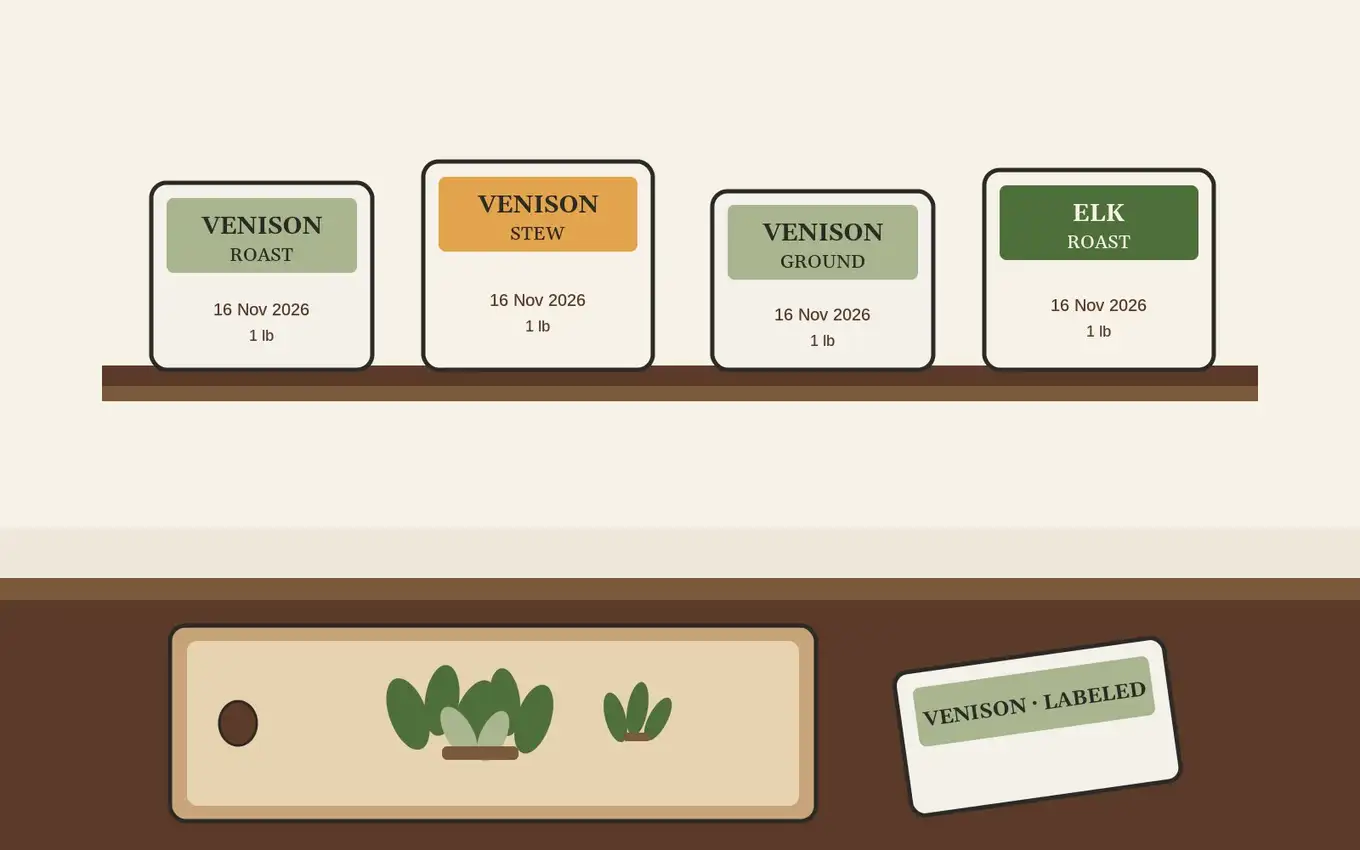
- Label each package with the contents and the date, using a permanent marker.
- Space packages in the freezer so air can move around them until they are solidly frozen (within 24 hours). After they are solid, you can restack them.
A chest or upright freezer that is already packed tight may not freeze a day’s worth of fresh packages in that 24-hour window. If you have a large animal, plan extra freezer space, or freeze in batches, so each package can actually go solid before you bury it.
Penn State states that properly wrapped game meat will store in the freezer for 9 to 12 months. That is the figure this article uses. It does not add a shorter “ground meat” window or a longer “steak” window, because those splits are not on the Penn State page cited here. If another USDA or Extension source, fetched at review time, gives a different range for a specific product, add that source and show both figures rather than inventing a number.
According to Penn State, the Pennsylvania Game Commission says it is legal to keep venison in home freezers year-round in Pennsylvania. That is a Pennsylvania rule, quoted as context. It is not a Colorado rule, and it is not permission to ignore your own state’s possession or storage regulations. Check CPW or your state wildlife agency if you have questions about how long you may keep game in a home freezer where you live.
Thawing and cooking
Thaw frozen game in the refrigerator, under cold running water, or in a microwave and then cook it immediately (Penn State). Do not thaw large packages on the counter.
When you cook, Penn State lists these internal temperatures, checked with a calibrated food thermometer:
- Whole cuts, steaks and roasts: 145°F (63°C), described there as medium rare.
- Ground meat: 160°F (71°C).
- Soups, stews, casseroles and leftovers: 165°F (74°C).
- Jerky: 160°F (71°C) before drying.
Those cooking temperatures are for safety, not for a preferred doneness past what the source states. Use the thermometer; color alone is not a reliable test, especially with lean game.
Jerky is a separate method, not just dried leftover steak. USDA FSIS says to heat meat to 160°F and poultry to 165°F before dehydrating, and to keep a dehydrator at 130–140°F. NCHFP describes two ways to reach 160°F: heating strips in marinade before drying, or heating dried jerky in a 275°F oven after drying, for the times NCHFP lists. FSIS emphasizes heating before drying, because bacteria become more heat-resistant after drying. A later article will walk through both pages; do not invent a drying time. Home-dried jerky storage, as both FSIS and NCHFP describe it, is on the order of one to two months (NCHFP specifies refrigeration below 40°F) — much shorter than the 9- to 12-month freezer window for raw, well-wrapped cuts. Curing and smoking belong in the same “tested source only” category. If a method uses nitrite, cite the Extension publication verbatim or point to it.
If you are waiting on a CWD test
Colorado Parks & Wildlife says you may process meat while you wait for CWD results, which can take up to five weeks (25 business days) according to CPW’s CWD page. If you use a commercial processor, CPW says to request separate packaging and to mark the packages clearly. Keep the carcass tag with the meat as required, and keep a written note of the hunt, the date and the test. If a result is positive, follow the current advice on CPW’s CWD page for whether to eat the meat, how to dispose of it, and any reimbursement. Those instructions are CPW’s, and they can change; this article does not replace them with a shorter house rule.
Testing requirements themselves are year- and hunt-code-specific. Confirm them in the current Big Game brochure and on the CWD page before you assume a test is or is not required. Animals harvested outside Colorado are not accepted at CPW submission sites. If you transport a carcass or wrapped meat across a state line, also follow the destination state’s import rules.
A simple way to keep all of this straight is a paper or spreadsheet log: harvest date, species, license and tag numbers, CWD sample or test number, cut list, package count, freeze date and the date you used the last package. The free Pantry & Food-Storage Inventory and Rotation Tracker already does this job for canned and stored food; a game-processing log can sit beside it. The Storage & Rotation Planner is the same idea in a longer format. Use first-in, first-out: the packages with the oldest freeze date come out first, inside that 9- to 12-month window.
A freezer checklist
- Cool the carcass to 35–40°F before you count on the freezer (Penn State; CSU in warm weather).
- Refrigerate unfrozen cuts and use them within two or three days (Penn State).
- Pack in meal-size portions, wrap tightly, label with contents and date, and freeze solid within 24 hours (Penn State).
- Plan on 9 to 12 months in the freezer for properly wrapped game meat (Penn State). Do not invent a different range.
- Thaw in the refrigerator, under cold water, or in a microwave and cook right away.
- Cook to the internal temperatures Penn State lists: 145°F for whole cuts, 160°F for ground meat, 165°F for leftovers.
- Log packages and rotate the oldest first. If a CWD test is pending, mark those packages and follow CPW if the result is positive.
- For jerky or a cured product, use FSIS, NCHFP or Extension — not an unsourced recipe.
Related reading
- Hunting, field care and home processing of game
- How to field-dress a deer and cool the carcass safely
- How to build and rotate a home food supply
- Free Pantry & Food-Storage Inventory and Rotation Tracker
About this article. The cooling, refrigerator, wrapping, freezer-life, thawing and cooking figures above come from Penn State Extension. Warm-weather cooling and aging context come from CSU Extension. CWD process-while-waiting advice comes from Colorado Parks & Wildlife. Furrow & Feast has not run its own freezer trials and does not invent shelf lives. Confirm your state’s possession rules and current CWD guidance before you store or transport game. This article was drafted with AI assistance from the listed sources. Approved for publication by Brian Favreau (Furrow & Feast), November 16, 2026.
Sources and further reading
- Penn State Extension, Proper Care and Handling of Venison from Field to Table
- Colorado Parks & Wildlife, Chronic Wasting Disease
- Colorado Parks & Wildlife, Deer in the Field
- Colorado Parks & Wildlife, Hunter Education
- Colorado Parks & Wildlife, home
- USDA FSIS, Jerky
- National Center for Home Food Preservation, Jerky
- Colorado State University Extension, Field Care of Big Game (published June 2010, reviewed August 2025)
Part of: Hunting, Field Care and Home Processing of Game: A Practical Guide
More in Hunting & Butchering
Other guides
- Food Preservation for Homesteaders: Canning, Dehydrating, Fermenting and Root Cellaring
- Long-Term Food Storage: Building a Pantry You Actually Use
- How Much to Plant: Sizing Your Vegetable Garden to Your Household
- Off-Grid Growing: A Garden That Keeps Producing Without the Grid
- Vegetable Garden Planning and Layout: Beds, Spacing and Sun
- Seed Saving: Grow Your Own Seed Supply, Year After Year
- Seed Starting by Frost Date: The Complete Beginner's Guide
- Small Livestock for the Homestead: Chickens, Rabbits, Goats and Bees
- Succession and Companion Planting: Keep Beds Productive All Season
- Weather Prep for the Homestead: Frost, Freeze and Storm Readiness